


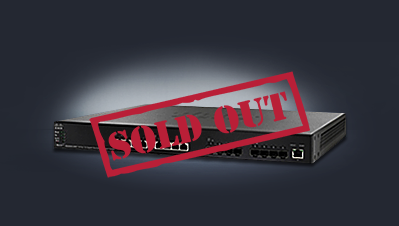

| Layer | Layer 2, 3 Switching |
| Spanning Tree Protocol | Standard 802.1d spanning tree support Fast convergence using 802.1w (Rapid Spanning Tree |
| [RSTP]),enabled by default Multiple spanning tree instances using 802.1s (MSTP); 16 instances | |
| Support for IEEE 802.3ad Link Aggregation Control Protocol (LACP) | |
| Port grouping/link aggregation | Support for IEEE 802.3ad Link Aggregation Control Protocol (LACP) |
| Up to 32 groups | |
| Up to 8 ports per group with 16 candidate ports for each (dynamic) 802.3ad LAG | |
| Voice VLAN | Voice traffic is automatically assigned to a voice-specific VLAN and treated with appropriate levels of |
| QoS. Auto voice capabilities deliver networkwide zero-touch deployment of voice endpoints and call | |
| control devices. | |
| VLAN | Support for up to 4094 active VLANs simultaneously; port-based and 802.1Q tag-based VLANs; |
| MAC-based VLAN Management VLAN Private VLAN with promiscuous, isolated, and community port | |
| Guest VLAN, unauthenticated VLAN, protocol-based VLAN, IP subnet-based VLAN, CPE VLAN | |
| Dynamic VLAN assignment using RADIUS server along with 802.1x client authentication | |
| Multicast TV VLAN | Multicast TV VLAN allows the single multicast VLAN to be shared in the network while subscribers |
| main in separate VLANs. This feature is also known as Multicast VLAN Registration (MVR). | |
| Unidirectional Link Detection (UDLD) | UDLD monitors physical connection to detect unidirectional links caused by incorrect wiring or port |
| faults to prevent forwarding loops and blackholing of traffic in switched networks. | |
| DHCP relay at Layer 2 | Relay of DHCP traffic to DHCP server in a different VLAN. Works with DHCP option 82. |
| IGMP (versions 1, 2, and 3) snooping | Internet Group Management Protocol (IGMP) limits bandwidth-intensive multicast traffic to only the |
| equesters; supports 4K multicast groups (source-specific multicasting is also supported). | |
| IGMP querier | IGMP querier is used to support a Layer 2 multicast domain of snooping switches in the absence |
| of a multicast router. | |
| HOL blocking | Head-of-line (HOL) blocking. |
| IPv4 routing | Wirespeed routing of IPv4 packets, Up to 7K routes and up to 256 IP interfaces |
| Wirespeed IPv6 static routing | Up to 7K routes and up to 256 IPv6 interfaces |
| Layer 3 interface | Configuration of Layer 3 interface on physical port, LAG, VLAN interface, or loopback interface |
| CIDR | Support for classless interdomain routing |
| RIP v2 | Support for Routing Information Protocol version 2 for dynamic routing |
| VRRP | Virtual Router Redundancy Protocol (VRRP) delivers improved availability in a Layer 3 network by |
| providing redundancy of the default gateway servicing hosts on the network. VRRP versions 2 and 3 are | |
| supported. Up to 255 virtual routers are supported | |
| Policy-based routing (PBR) | Flexible routing control to direct packets to different next hop based on IPv4 or IPv6 ACL |
| DHCP server | Switch functions as an IPv4 DHCP server serving IP addresses for multiple DHCP pools/scopes. |
| Support for DHCP options | |
| DHCP relay at Layer 3 | Relay of DHCP traffic across IP domains |
| User Datagram Protocol (UDP) relay | Relay of broadcast information across Layer 3 domains for application discovery or relaying of |
| BOOTP/DHCP packets | |
| Console port | Cisco Standard RJ45 console port |
| OOB management port | Dedicated Gigabit management port for out-of-band management on SG550XG models |
| RPS | RPS connector |
| USB slot | USB Type-A slot on the front panel of the switch for easy file and image management |
| Buttons | Reset button |
| Cabling type | Unshielded twisted pair (UTP) Category 5 or better; fiber options (SMF and MMF); coaxial SFP+ |
| LEDs | System, master, fan, RPS, stack ID, link/speed per port |
| Power | 100 - 240V 47 - 63 Hz, internal, universal |
| Certification | UL (UL 60950), CSA (CSA 22.2), CE mark, FCC Part 15 (CFR 47) Class A |


































 PC
PC
 All in one
 Notebook
 Monitor
 Printer
 Hosting
 Google cloud
 AWS
AWS
 Huawei cloud
 SSL
SSL